


Quick Answer
Most B2B marketing funnels don’t fail because of bad ads or weak creative. They fail because they’re not built as part of an overarching system. To be clear, the marketing funnel might be running as a system unto itself, but it’s most likely in a silo when you zoom out to look at the bigger picture. When marketing, sales, and client success run on separate tracks, leads leak out faster than they come in and marketing to sales handoffs are sloppy. A real funnel connects every touchpoint into one seamless process that moves prospects from awareness to advocacy.
Table of Contents:
Why Most B2B Marketing Funnels Fail and How to Build One That Actually Works
The Funnel Problem No One Talks About
Four Reasons Why Your Marketing Funnel Isn’t Working
What a Working B2B Flywheel Looks Like
How to Fix Your B2B Funnel (the Honeycomb Client Flywheel way)
FAQs about B2B Marketing Funnels
The Funnel Problem No One Talks About
You’ve seen the diagrams: colorful triangles labeled Awareness, Consideration, Decision. They look great in decks but don’t reflect reality in the B2B world. After decades of doing this, I’ve seen that most funnels stop at lead capture then forget what happens next. That’s where revenue leaks right out the bottom of the bucket in the way of lost opportunities.
I’ve audited hundreds of B2B funnels in professional services, technology and consulting firms. Nearly every one shared similar problems: dozens of entry points with few exits that lead to sales or renewals.
It’s not because your marketing and sales team don’t know better. It’s because they’re buried in disconnected tasks like posting content, updating CRMs, running ad and email campaigns, and following up manually. Without one connected system, they end up guessing what actually drives growth.
That’s why I built the Buzzworthy Revenue Engine™, a framework that replaces random acts of marketing through funnels with a repeatable, data-driven growth system.
Four Reasons Why Your Marketing Funnel Isn’t Working
- It’s built for volume.
Many funnels chase leads instead of buyers. High lead counts look impressive on dashboards, but if your sales team can’t convert them, you’re just feeding noise into the matrix. I’d rather have 50 quality leads in my database than 2,000 less than average leads in my CRM. - Marketing and sales play different games.
When success is measured differently, collaboration breaks down. Marketing celebrates Marketing Qualified Leads (MQLs), while sales celebrate Sales Qualified Leads. Friction comes when sales complains that MQL quality is low and marketing complains that sales isn’t converting perfectly goo MQLs into SQLs and so on. This friction kills lead flow and wastes opportunities that are sitting right under our noses. - There’s no defined handoff.
If your CRM doesn’t automate assignments, reminders, and follow-ups, leads go cold fast. A missing process at this stage can cut close rates in half. - The funnel ends too early.
Too many B2B funnels stop after the sale. The contract is signed and so the process is complete, right? But what if I told you that the real growth happens after that through the onboarding process, retention, expansion, and referrals. Every client interaction is part of the funnel.

What a Working B2B Flywheel Looks Like
A functional funnel isn’t a triangle, it’s a flywheel. Each stage builds momentum for the next: creating, converting, and compounding value.
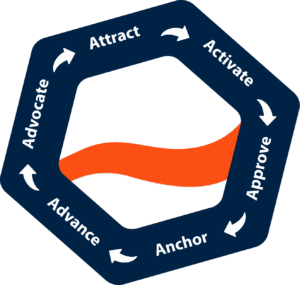
| Stage | Focus | Goal |
| Attract | Create and capture right-fit demand through precise positioning, authority content, and value-led outreach. | Fill your pipeline with qualified interest from ideal buyers. |
| Approve | Qualify prospects, propose solutions that fit, and reach mutual commitment to move forward. | Turn alignment into opportunity. |
| Activate | Onboard clients efficiently and guide them to their first value as quickly as possible. | Deliver early wins that build long-term trust. |
| Anchor | Sustain value by managing risk, measuring outcomes, and keeping communication proactive. | Strengthen relationships and retention. |
| Advance | Identify ways to deepen impact and grow account value through strategic expansion. | Turn results into growth. |
| Advocate | Ask for testimonials, referrals, and participation in case studies to create a revenue feedback loop. | Turn satisfied clients into champions who drive new demand. |
A connected funnel works like a growth engine. Instead of constant starts and stops, it compounds progress.

"Buzzworthy Marketing has helped us bring clarity and focus to our marketing and sales funnel. They built a connected system that finally gives us measurable, predictable results. The communication and responsiveness have been outstanding."
Eric Calinisan
CEO, Calinisan Management Services
How to Fix Your B2B Funnel (the Honeycomb Client Flywheel way)
If you want a funnel that reliably turns interest into revenue, start by looking at it through the six stages of the Honeycomb Client FlywheelTM—Attract → Approve → Activate → Anchor → Advance → Advocate—and tighten up the experience within each pass of the baton.
1) Start with a Funnel Diagnostic
Grab a whiteboard or a simple doc and sketch the six stages across the top. Under each one, write two quick lines: what should happen, and what actually happens. Then capture three simple numbers—how many opportunities are in the stage, what percentage move forward, and how long they sit there. That little exercise does two things: it shows you where leads, retention, expansion, and referrals leak out, and it reveals the friction (slow responses, clunky forms, missing proof, slow to no wins) that makes good prospects quietly disappear.
The goal isn’t to fix everything. It’s to name one clearly urgent bottleneck and address it now. That one improvement—tightening the handoff, clarifying the next step, adding a proof asset—often lifts total funnel progression noticeably because it improves flow for every stage behind it.
2) Align your teams
Shared language creates shared accountability. Decide together what a Qualified Lead actually is (we use P3P—the Predictably Profitable Prospect Profile—to keep it honest) and agree on the two-way approval/greenlight moment when both sides confirm fit and a next step. Then write it down like real operating rules: who responds to new leads, by which channel, and how fast; what has to be true for a lead to enter a stage; what earns them out of it; and who owns the baton at each step. One owner per stage. No “shared” owners.
Keep the rhythm light but consistent. A 30-minute weekly Funnel Huddle is enough: look at the same small scoreboard, talk through stuck deals that have aged past your standard, and pick one improvement to ship before next week.
3) Improve your nurture sequences
Nurture isn’t a drip campaign; it’s simply answering the right questions in the right order before you ask for time. Start with a Question Bank mined from successful sales calls, lost deals, and support tickets. Early on (Attract and Approve), prospects ask “Do we even have this problem?” “What happens if we do nothing?” and “How do you compare to X?” As they move closer (Activate and Anchor), they want to know “What happens in week one?” “Who needs to be involved?” and “How will we measure early wins?” Later (Advance and Advocate), the questions shift to “What expansion typically pays off next?” and “What results can we share?”
Match those questions with simple assets: a short case snapshot, a comparison guide, an ROI calculator, an implementation timeline, a first-value checklist. Then sequence them. In the first week after a hand-raise, send a value recap, a proof asset, and a clear next step. Over the next month, mix email, LinkedIn, and short videos—each message tied to one question from your bank. Every quarter, come back with “What changed?” and something fresh that answers a question they’re now asking.
4) Automate for consistency, not replacement
Automation keeps promises; people build trust. Use it to make sure every lead is acknowledged instantly with a helpful asset and a clear next step. Route and enrich records so the right owner sees the right context. Keep your hygiene tight: dedupe automatically, enforce required fields, and nudge deals that sit too long in a stage. Create tasks for human moments that matter: timely follow-ups, quarterly planning packs, renewal check-ins. Feed delivery signals back to sales: if a health score dips or a milestone hits, surface that as a prompt for a real conversation. And don’t forget closed-lost surveys; nothing improves messaging faster than honest “why we didn’t win.”
But keep the human moments human. Discovery, pricing, and value conversations are where trust forms. Don’t automate empathy.
5) Close the feedback loop
Your client success team is sitting on gold. Turn their insights into a loop. Ask for a simple monthly page: a 0–100 health score, goal vs. actual, and a short note on risks. Each quarter, bundle the highlights into a planning pack that include what outcome you delivered, what unlocked it and the next best expansion based on proof. Tag win/loss/churn reasons in your CRM so marketing can see patterns and sharpen the narrative.
This goes beyond internal housekeeping. It’s how you create magnets. Outcomes become case studies that answer real objections (“Implementation is heavy” turns into a 14-day first-value timeline). And it gives you clear stage gates: moving from Anchor to Advance when the account is in sustained green health with a documented outcome and from Advance to Advocate when expansion results are real and the client is ready to share a testimonial or a referral.
6) Track what matters
Don’t drown in dashboards. A predictable funnel rests on a small set of numbers you review every week: qualified leads by source, how fast you respond, show rates for first calls, stage-to-stage conversion, velocity (time in stage and total cycle time), average contract value, retention/NRR, and expansion/attach rate. That data set is enough to forecast using a simple formula:
Pipeline Value x Win Rate ÷ average cycle length, gives you a forward weekly revenue pace. Look at it by source and you’ll know exactly where to invest or pull back.
A few practical nudges
If you’re wondering where to start, start with speed. Response time is the easiest lever and regularly the biggest. Decide on a standard, route new leads to a live notifications channel, and send two thoughtful touches in the first 24 hours: one helpful asset and one low-friction invite to book.
Next, simplify your forms. Keep only the fields you actually use to qualify or route. Anything else can wait for progressive profiling after you’ve earned a conversation. If your offer is a consult, test “Book a Call” with a short pre-qual instead of a long “download” form that leads nowhere.
Then segment follow-ups by intent and role. Evaluators and Economic Buyers don’t ask the same questions at the same time. Neither do Doers and Deciders. When your message meets the question they’re actively asking, personalization beats generic automation every time.
And give your CRM thirty clean minutes every Friday. Advance the deals that moved, close out the ones that didn’t, fix “no owner/no next step,” and clear duplicates. A clean system makes a clear funnel.
Putting it all together
Here’s a simple 30-day sprint that works: spend a week mapping the six stages and collecting baseline numbers, then choose one bottleneck you can actually fix. Ship a concrete improvement—maybe it’s a response-time rule with routing and alerts, or a short case snapshot slotted into your early nurture. Kick off your weekly Funnel Huddle and review the same small scoreboard every time. At the end of the month, measure what changed. If conversion or velocity moved, lock it in and celebrate. If it didn’t, re-triage and tackle the next most urgent struggle.
That’s the Honeycomb way: focus the funnel, prove one improvement, and let the flywheel compound your wins.
FAQs about B2B Marketing Funnels
Q: What’s the difference between a marketing funnel and a revenue engine?
A funnel captures leads. A revenue engine connects every stage (marketing, sales, and client success) so leads stay and grow.
Q: How do I know if my sales and marketing funnels are broken?
If your CRM is full of cold contacts, your conversion rates keep dropping, or marketing blames sales (and vice versa), your funnel isn’t functioning as a system.
Q: What are the most common funnel leaks in B2B marketing?
The biggest leaks happen at handoffs: marketing to sales, sales to client success, and post-onboarding follow-up. Each gap costs you future revenue if it’s not systemized.
Q: How do you measure the health of a funnel?
Track more than lead volume. Focus on velocity (how quickly leads move), cost per acquisition, conversion rates by source, and customer retention.
Q: Should I rebuild or repair my funnel?
Start with diagnostics. Most funnels don’t need a total rebuild. They just need clean data, consistent automation, and tighter messaging between teams.
Q: What type of content works best at each funnel stage?
- Awareness: Educational blogs, thought leadership, and SEO articles.
- Consideration: Case studies, ROI calculators, comparison guides.
- Decision: Demos, proof, and testimonials that reduce risk.
Q: How long does it take to fix or optimize a funnel?
With clear priorities and alignment, most firms see measurable improvements within 60–90 days. Predictability comes with refinement over time.
Q: Does this mean replacing our CRM or marketing tools?
Usually not. Most firms already have the tools, but they just aren’t connected or configured for efficiency.
You may think you need more traffic but a better flow and connected funnel turns marketing chaos into momentum, guiding prospects from first click to loyal client.
Ready to find your leaks? Schedule a Growth Diagnostic and see how your funnel can finally start working with you, not against you.